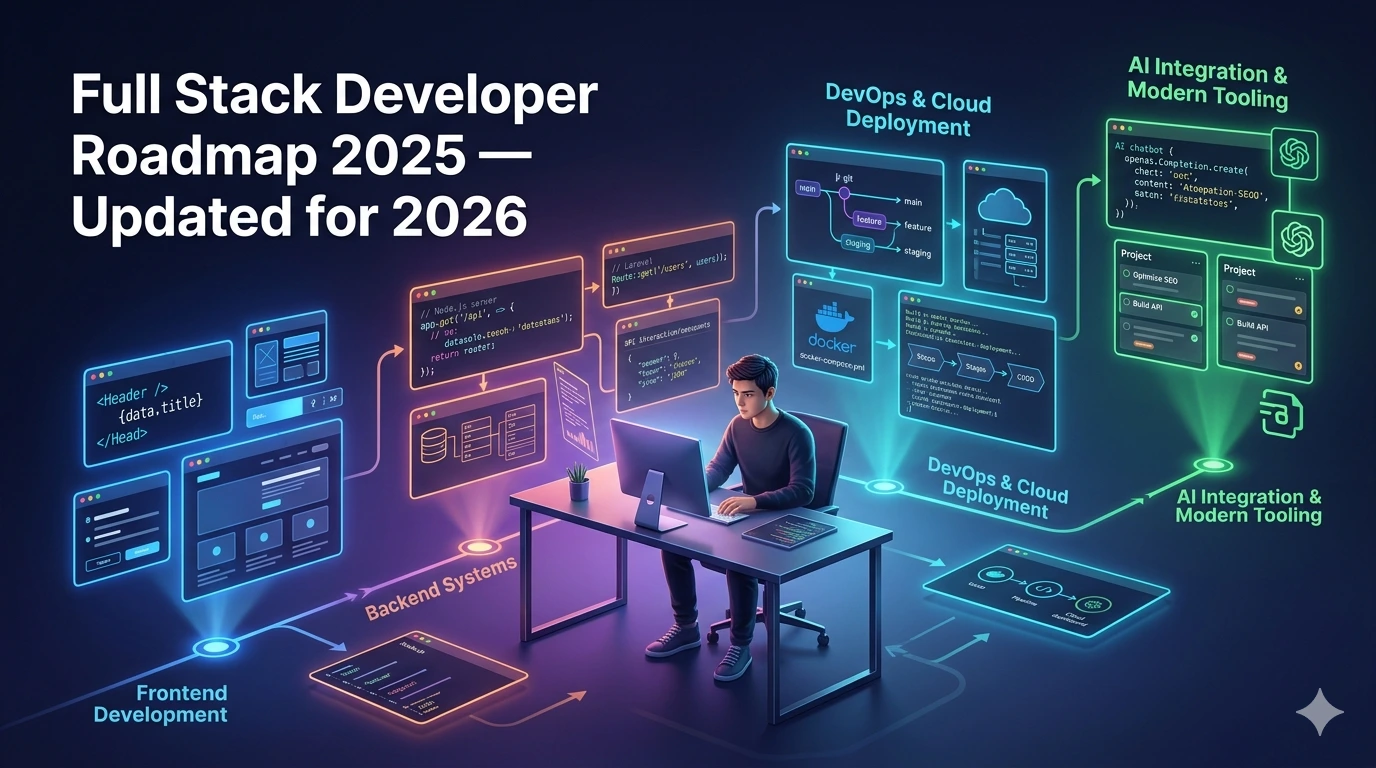
Full Stack Developer Roadmap — Complete 2026 Guide
Full Stack Developer Roadmap 2025 — Complete Guide (Updated May 2026)
Last updated: May 26, 2026
Most roadmaps show you a wall of technologies and leave you wondering where to start. This one tells you what to learn, in what order, why each thing matters, and what to build at each stage to prove you've learned it.
I'm Abhishek — a full stack developer who has shipped five production applications using Laravel, React, Next.js, and Node.js. This is the roadmap I wish someone had handed me when I started. Not a Wikipedia list of every technology that exists. A clear, honest path from zero to employed.
What "Full Stack" Actually Means in 2026
The definition has evolved. In 2026, companies increasingly look for full stack developers who can design, build, and maintain complete solutions across both front-end and back-end layers. But the expectation has gone further than that. GitHub
The full-stack developer role in 2026 demands more than technical versatility — it requires strategic thinking, continuous learning, and the ability to translate technology into business value. G2
That last part is what separates developers who get hired from developers who are still applying. Technical skills get you through the screening. The ability to own a product end-to-end and communicate about it clearly is what gets you the offer.
In practical terms, a full stack developer in 2026 can:
- Build a complete frontend interface (React, Next.js, TypeScript)
- Design and build a backend API (Node.js, Laravel, or both)
- Model and manage a database (PostgreSQL, MySQL, MongoDB)
- Deploy and maintain a production application (Vercel, Railway, AWS)
- Integrate AI capabilities into web products (a new expectation in 2026)
- Debug problems across the entire system — not just "their layer"
That final point is what most roadmaps miss. Full stack doesn't mean knowing two separate halves. It means understanding how the layers interact — how a slow database query causes a 3-second page load, how an incorrect API response breaks a frontend component, how a misconfigured environment variable takes your app offline at 2am.
The Real-World 2026 Tech Stack
Before the roadmap, here is what companies are actually hiring for right now. The most important full stack developer skills in 2026 include front-end frameworks (React, Vue, Angular), backend technologies (Node.js, Python, Java), REST and GraphQL APIs, cloud computing, DevOps tools, and database management. ColorWhistle
For the web developer track specifically, the dominant production stack in 2026 is:
LayerTechnologiesFrontendReact 19, Next.js 15, TypeScriptStylingTailwind CSS, shadcn/uiBackendNode.js / Express, or Laravel 13 / PHP 8.3DatabasePostgreSQL (primary), MySQL, Redis (cache)ORMPrisma (Node.js) or Eloquent (Laravel)AuthNextAuth.js, Laravel Sanctum, ClerkDeploymentVercel (frontend), Railway / Fly.io (backend)DevOpsDocker, GitHub Actions, basic cloud (AWS/GCP)AIOpenAI API, Anthropic API, basic LLM integration
One thing that genuinely changed in 2025–2026: Artificial Intelligence is not replacing developers — it is enhancing them. Full-stack developers who integrate AI APIs, machine learning models, and cloud AI tools into web applications are significantly more valuable. This is no longer optional knowledge. Recruiters are asking about it. ININDIA
The Full Stack Roadmap — Stage by Stage
Stage 1 — The Foundation (Months 1–3)
Do not skip this. Developers who skip the fundamentals and jump straight to frameworks spend twice as long debugging because they have no mental model for how things actually work.
HTML and CSS — Weeks 1 and 2
Every layout you can see on any website maps to HTML elements and CSS rules. Your goal is to look at any interface and know how you would build it.
Focus on:
- Semantic HTML — nav, main, article, section, header, footer. Not everything is a div.
- CSS Flexbox — for one-dimensional layouts (rows, columns)
- CSS Grid — for two-dimensional layouts (the whole page structure)
- Responsive design — mobile-first media queries
- CSS custom properties (variables)
Build this: a static personal portfolio. HTML and CSS only. No JavaScript, no frameworks. Make it fully responsive. This forces you to actually use Flexbox and Grid rather than just reading about them.
JavaScript — Weeks 3 through 8
JavaScript is the most important thing you will learn. Every framework is JavaScript underneath. If you don't understand JavaScript deeply, you will spend years struggling with frameworks without knowing why.
Do not jump to React yet. I see this mistake constantly — developers who "know React" but cannot explain closures, the event loop, or array methods. When the framework surprises them, they have no way to debug it.
Core concepts to master, in this order:
- Variables, data types, scope, and closures
- Arrays — every method: mao, filter, reduce, find, forEach, some, every
- Objects — destructuring, spread operator, optional chaining
- Asynchronous JavaScript — callbacks → Promises → async/await . Learn them in that sequence. Each one exists because the previous one had problems.
- DOM manipulation — even if you never use it in production, understanding it explains what React is actually doing for you
- ES6+ features — template literals, arrow functions, modules, nullish coalescing
Build this: a todo application in plain JavaScript, no libraries. It sounds boring. It is not. It forces you to handle state (the list), DOM updates (add/remove items), and events (clicks, keyboard) — the exact same concepts React manages for you, just without the abstraction.
Git — Start Week 1
Git is not something you learn after you feel ready. Start using it from your first day of learning. Every project goes on GitHub. Your GitHub profile is a live portfolio that employers look at before they even read your resume.
Commands to know cold:
bash
git init
git add .
git commit -m "message"
git push origin main
git pull
git branch feature-name
git checkout feature-name
git merge feature-name
git status
git log --oneline
One rule: commit every time you finish a meaningful piece of work. Not at the end of the day. Not when the feature is done. Every time you get something working.
The terminal — Start Week 1
Every professional developer tool runs from the terminal. Stop using GUI tools as a crutch.
bash
ls            # list files
cd folder     # change directory
mkdir name    # make a new folder
touch file    # create a new file
cat file      # read a file
grep "text" . # search for text in files
curl -I URL   # check a URL's HTTP response
Learn these early. They appear everywhere.
Stage 2 — Frontend Development (Months 3–6)
React — Months 3 through 5
React is the most important frontend skill in the job market globally in 2026. Next.js is built on React. Most large-scale web applications you will work on professionally use React or a React-adjacent framework.
Learn these concepts, in this exact order:
- Components — functions that return JSX. Everything in React is a component.
- Props — how data flows from parent to child. One direction only. Always.
- useState — how a component remembers things that change.
- useEffect — how to run code in response to changes.
- Event handling — onClick, onChange, onSubmit.
- Conditional rendering — showing different UI based on state.
- Lists and keys — rendering arrays of data.
- Forms — controlled inputs, validation, submission.
Then move to intermediate concepts:
- useContext — sharing state across components without prop drilling
- Custom hooks — extracting reusable logic into functions
- React Query / TanStack Query — the modern way to fetch and cache server data
- Error boundaries — handling component failures gracefully
Build this: a weather dashboard. Fetch data from a public weather API. Display it dynamically. Handle loading and error states. Add a search input for different cities. This single project covers async data fetching, conditional rendering, form handling, and dynamic lists — four of the most common patterns in any real application.
TypeScript — Month 5
Start TypeScript in month 5, not later. TypeScript is now the standard in professional codebases. Most job postings list it as required or preferred. Modern stack fluency in React, Node.js, TypeScript, and cloud platforms dominates today's job descriptions. SeoProfy
TypeScript is JavaScript with types added. The learning curve is smaller than people expect:
typescript
// JavaScript
function getUserName(user) {
  return user.name
}

// TypeScript — same thing, with a type
interface User {
  id: number
  name: string
  email: string
}

function getUserName(user: User): string {
  return user.name
}

// Now this gives an error before the code even runs:
getUserName({ id: 1 })
// Error: Property 'name' is missing in type '{ id: number }'
The value is catching these errors at development time rather than in production at 2am. In React with TypeScript, you type your component props:
typescript
interface ButtonProps {
  label: string
  onClick: () => void
  variant?: 'primary' | 'secondary' | 'ghost'
  disabled?: boolean
}

function Button({ label, onClick, variant = 'primary', disabled = false }: ButtonProps) {
  return (
    <button
      className={`btn btn-${variant}`}
      onClick={onClick}
      disabled={disabled}
    >
      {label}
    </button>
  )
}
If someone passes disabled="yes" instead of disabled={true}, TypeScript catches it immediately. This saves hours of debugging.
Next.js — Months 5 through 6
Next.js is the production React framework. It adds server-side rendering, static generation, file-based routing, and a built-in API layer. In 2026, Next.js 15 with the App Router is the current standard.
What Next.js gives you over plain React:
- Pages load faster because HTML is generated on the server
- Better SEO because search engines get full HTML, not a blank page waiting for JavaScript
- File-based routing — a file at app/about/page.tsx becomes /about automatically
- Server Components — components that run on the server and send pure HTML (no JavaScript shipped to the browser)
- API routes — backend endpoints in the same project
Build this: a blog site using Next.js. Use static generation for the blog posts. Add a contact form using an API route. Deploy it to Vercel. This covers the three most important Next.js concepts in one project.
Stage 3 — Backend Development (Months 6–9)
Choose your backend: Node.js or Laravel
This is the most common question I get. Here is the honest answer:
Choose Node.js if: you want to use one language (JavaScript/TypeScript) across the entire stack. This is the most common choice in US and European startups. The mental overhead of switching between languages is real, and staying in TypeScript throughout the full stack is genuinely productive.
Choose Laravel (PHP) if: you want a framework that comes with everything built in — authentication, queues, job scheduling, mail, real-time events, file storage, and an elegant ORM. Laravel is faster to get to a working product for backend-heavy applications. It powers a significant portion of the world's web applications and is the framework I use for complex backend projects.
You do not have to choose only one forever. Learn one deeply first, then add the other. I use both.
Node.js and Express — Months 6 through 7
Node.js is JavaScript running on the server. If you already know JavaScript, you already know most of it. What you're learning is the server-specific parts.
Your first working REST API:
javascript
import express from 'express'
import cors from 'cors'

const app = express()
app.use(express.json())
app.use(cors())

// In-memory store for demo (use a database in production)
let posts = [
  { id: 1, title: 'Hello World', content: 'My first post' }
]

// GET all posts
app.get('/api/posts', (req, res) => {
  res.json({ data: posts, total: posts.length })
})

// GET single post
app.get('/api/posts/:id', (req, res) => {
  const post = posts.find(p => p.id === Number(req.params.id))
  if (!post) return res.status(404).json({ error: 'Post not found' })
  res.json({ data: post })
})

// CREATE post
app.post('/api/posts', (req, res) => {
  const { title, content } = req.body
  if (!title || !content) {
    return res.status(422).json({ error: 'Title and content are required' })
  }
  const post = { id: Date.now(), title, content }
  posts.push(post)
  res.status(201).json({ data: post })
})

// UPDATE post
app.put('/api/posts/:id', (req, res) => {
  const index = posts.findIndex(p => p.id === Number(req.params.id))
  if (index === -1) return res.status(404).json({ error: 'Post not found' })
  posts[index] = { ...posts[index], ...req.body }
  res.json({ data: posts[index] })
})

// DELETE post
app.delete('/api/posts/:id', (req, res) => {
  posts = posts.filter(p => p.id !== Number(req.params.id))
  res.status(204).send()
})

app.listen(3000, () => console.log('API running on http://localhost:3000'))
This is a complete CRUD API in under 40 lines. Understand every line. That understanding is what lets you extend it.
Core concepts to master:
- Request and response cycle — what actually happens when a browser makes an HTTP request
- Route parameters and query strings — /posts/:id vs /posts?page=2
- Middleware — functions that run between the request and your handler (authentication, logging, parsing)
- Error handling middleware — a catch-all at the bottom that handles everything
- Environment variables with dotenv — never put secrets in your code
Databases — Months 7 through 8
PostgreSQL (learn this first)
Relational databases store data in tables with defined relationships. Most real-world business applications — user accounts, orders, bookings, events — use relational databases because the relationships between data actually matter.
The SQL you must know cold:
sql
-- The four fundamental operations
SELECT * FROM users WHERE is_active = true ORDER BY created_at DESC;
INSERT INTO users (name, email, password_hash) VALUES ('Abhishek', 'a@devabhi.site', 'hash');
UPDATE users SET last_login = NOW() WHERE id = 1;
DELETE FROM users WHERE id = 1;

-- Joins — the most important SQL concept
SELECT
  users.name,
  users.email,
  COUNT(orders.id) AS total_orders,
  SUM(orders.total) AS total_spent
FROM users
LEFT JOIN orders ON users.id = orders.user_id
GROUP BY users.id, users.name, users.email
ORDER BY total_spent DESC;

-- Indexes — make slow queries fast
CREATE INDEX idx_users_email ON users(email);
CREATE INDEX idx_orders_user_id ON orders(user_id);
Prisma (for Node.js) — the modern ORM
Instead of writing raw SQL for every query, Prisma gives you type-safe database access:
typescript
// Define your schema once
// prisma/schema.prisma
model User {
  id        Int      @id @default(autoincrement())
  email     String   @unique
  name      String
  posts     Post[]
  createdAt DateTime @default(now())
}

model Post {
  id        Int      @id @default(autoincrement())
  title     String
  content   String
  published Boolean  @default(false)
  author    User     @relation(fields: [authorId], references: [id])
  authorId  Int
}

// Then query with full TypeScript autocomplete
const user = await prisma.user.findUnique({
  where: { email: 'a@devabhi.site' },
  include: {
    posts: {
      where: { published: true },
      orderBy: { createdAt: 'desc' },
    }
  }
})
// user.posts is fully typed — no guessing, no runtime errors
Authentication — Month 8
Every application with user accounts needs authentication. Two approaches:
JWT (JSON Web Tokens) — the server returns a signed token on login. The client sends it with every request. The server verifies the signature. No session storage needed.
typescript
// Login endpoint — generates a token
app.post('/auth/login', async (req, res) => {
  const { email, password } = req.body
  const user = await prisma.user.findUnique({ where: { email } })

  if (!user || !await bcrypt.compare(password, user.passwordHash)) {
    return res.status(401).json({ error: 'Invalid credentials' })
  }

  const token = jwt.sign(
    { userId: user.id, email: user.email },
    process.env.JWT_SECRET,
    { expiresIn: '7d' }
  )

  res.json({ token, user: { id: user.id, name: user.name, email: user.email } })
})

// Middleware to protect routes
function requireAuth(req, res, next) {
  const token = req.headers.authorization?.split(' ')[1]
  if (!token) return res.status(401).json({ error: 'Token required' })

  try {
    req.user = jwt.verify(token, process.env.JWT_SECRET)
    next()
  } catch {
    res.status(401).json({ error: 'Invalid or expired token' })
  }
}

// Protected route
app.get('/api/me', requireAuth, async (req, res) => {
  const user = await prisma.user.findUnique({ where: { id: req.user.userId } })
  res.json({ data: user })
})
Laravel as a backend option — Months 8 through 9
Laravel 13 launched on March 17, 2026, with zero breaking changes, a 10-minute upgrade path from Laravel 12, and features that advance what teams can build and how fast they can build it. Laravel powers more than 960,000 websites and holds over 50% of the PHP framework market. GitHub
Laravel's key advantage over raw Node.js is the sheer amount that comes built in:
bash
# Scaffolding a complete authentication system — one command
php artisan breeze:install

# Creating a resource controller with all CRUD methods — one command
php artisan make:controller PostController --resource

# Database migrations are version-controlled, like Git for your schema
php artisan make:migration create_posts_table
php artisan migrate

# Queues, jobs, events, mail, file storage, scheduled tasks
# — all included, zero additional packages needed
If you want to see Laravel in action, I've built the Event Management Portal and the SAF Demands Bidding Platform entirely with Laravel. Both involve complex multi-role authentication and business logic that Laravel handles elegantly.
Stage 4 — Production Skills (Months 9–12)
Deployment — Month 9
Knowing how to build is not enough. Knowing how to ship is what separates professional developers from hobbyists.
Vercel for Next.js frontend:
bash
# Three commands to go from code to live site
npm install -g vercel
vercel login
vercel --prod
Vercel auto-deploys from your GitHub main branch. Every pull request gets a preview URL. Rollbacks take one click. For Next.js specifically, this is the best deployment option in 2026.
Railway for backend APIs and databases:
Railway handles Node.js APIs, Laravel apps, PostgreSQL databases, Redis — all in one platform with a free tier. Connect your GitHub repo, add your environment variables, and it deploys automatically on every push.
Docker — basic literacy (Month 10)
You do not need to be a Docker expert, but you must understand containers:
dockerfile
# Dockerfile — containerize your Node.js API
FROM node:20-alpine
WORKDIR /app
COPY package*.json ./
RUN npm ci --only=production
COPY . .
EXPOSE 3000
CMD ["node", "dist/server.js"]
yaml
# docker-compose.yml — run your full stack locally with one command
services:
  api:
    build: ./backend
    ports:
      - "3000:3000"
    environment:
      DATABASE_URL: postgresql://postgres:password@db:5432/myapp
    depends_on:
      - db
  db:
    image: postgres:16-alpine
    environment:
      POSTGRES_PASSWORD: password
      POSTGRES_DB: myapp
    volumes:
      - postgres_data:/var/lib/postgresql/data

volumes:
  postgres_data:
docker-compose up starts your entire application — API, database, and any other services — with one command. Your code runs identically on your machine, your colleague's machine, and the production server. This eliminates the "it works on my machine" problem entirely.
AI Integration — The New Required Skill for 2026
This is the section that wasn't in any roadmap two years ago. A full-stack development course with AI teaches developers how to integrate AI APIs, machine learning models, and cloud AI tools into web applications. This makes a full stack developer significantly more valuable in 2026 than before. ININDIA
You do not need to train machine learning models. You need to know how to call AI APIs and integrate their outputs into a web application.
The simplest possible AI integration — a chat endpoint in your API:
typescript
// Using the OpenAI SDK in a Node.js API
import OpenAI from 'openai'

const openai = new OpenAI({ apiKey: process.env.OPENAI_API_KEY })

app.post('/api/chat', requireAuth, async (req, res) => {
  const { message, history } = req.body

  const completion = await openai.chat.completions.create({
    model: 'gpt-4o',
    messages: [
      {
        role: 'system',
        content: 'You are a helpful assistant for a developer portfolio site.'
      },
      ...history, // previous messages in the conversation
      { role: 'user', content: message }
    ],
    max_tokens: 500,
  })

  res.json({
    reply: completion.choices[0].message.content,
    usage: completion.usage
  })
})
Start with this. Then explore: generating content, summarising user input, classifying data, generating image descriptions. These are the AI features clients are paying for right now.
Stage 5 — Career and Portfolio (Months 11–12)
What actually gets you hired in 2026
The job market changed between 2024 and 2026. There are more junior developers than ever, AI code assistants are producing more code than ever, and companies have raised the bar for what a junior-to-mid developer needs to show. What separates candidates who get offers:
- A portfolio of real projects that solve real problems. Not tutorial clones. My five projects — a travel booking platform, real-time quiz app, event management system, CMS platform, and automated bidding system — each solve a specific business problem. That matters. View them at devabhi.site/projects.
- A public presence. GitHub with active commits, a technical blog, or contributions to open source. Recruiters search for you before they interview you.
- TypeScript. Modern stack fluency is non-negotiable — candidates who cannot show TypeScript usage are screened out early at most companies now. SeoProfy
- End-to-end ownership. Companies value developers who can design, build, and maintain complete solutions. A portfolio that shows a deployed, working application is worth ten times a list of technologies on a resume. GitHub
Salary expectations for 2026
On average, a full stack developer in India earns between ₹6 lakh and ₹15 lakh per year, depending on experience, location, and tech stack. The ceiling moves significantly with specialisation and international clients. Link Assistant
The average salary for a full stack developer in a remote role is $171,179 per year in the US market. For Indian developers working remotely for international clients, contract developers working globally can earn ₹5–10 lakh+ per month. Mangools
The path to international rates is through a portfolio that demonstrates production-level capability, not just tutorial projects.
What to Learn vs What to Skip in 2026
Learn these:
- Next.js 15 with App Router — the current direction of React
- TypeScript — table stakes in professional codebases
- PostgreSQL — the relational database that scales
- Prisma or Eloquent — type-safe database access
- Docker basics — container literacy is now expected
- One AI API integration — OpenAI or Anthropic
- Vercel/Railway — learn deployment in month one, not at the end
Skip for now:
- Angular — declining relative market share, steep learning curve
- Java Spring Boot — valuable but adds complexity for web development beginners
- GraphQL — learn REST deeply first; GraphQL's benefits only become real at scale
- Kubernetes — too advanced for this stage; Docker Compose handles local orchestration
- Multiple backend languages — go deep on one, Node.js or Laravel, before adding another
A Realistic Timeline
MonthFocusProject to build1HTML, CSS, Git, terminalStatic responsive portfolio2–3JavaScript deep diveTodo app, weather dashboard4React fundamentalsFull CRUD app with state5TypeScript + ReactTyped component library5–6Next.jsBlog with API routes, deployed7Node.js, Express, SQLREST API with PostgreSQL8Auth + Prisma ORMFull stack app with login9Laravel (optional)API with Sanctum auth10Docker + deploymentEverything deployed and live11AI integrationChatbot or content generator feature12Portfolio polish + job prepAll projects live, blog active
Full time: 12 months to junior full stack developer. Part time: 18–24 months. The variable is not intelligence — it is the number of real projects you finish and deploy.
Conclusion
The full stack developer path in 2026 is more defined than it has ever been. The tools have consolidated: React and Next.js on the frontend, Node.js or Laravel on the backend, TypeScript throughout, PostgreSQL for data, Docker for consistency, and at least one AI integration to stay relevant.
What has not changed: the discipline to finish projects instead of starting them. The willingness to read error messages carefully instead of guessing. The habit of pushing code to GitHub even when it feels incomplete.
Build things. Ship them. Write about what you learned. The developers who are getting hired in 2026 are not the ones who know the most — they are the ones who have shown the most.
Comments (0)
No comments yet. Be the first!